


About our services
Virtual care (telehealth), is a safe and easy way to connect with a health professional using video technology. Virtual care helps patients get the right care quickly and offers benefits for everyone, no matter where they are.
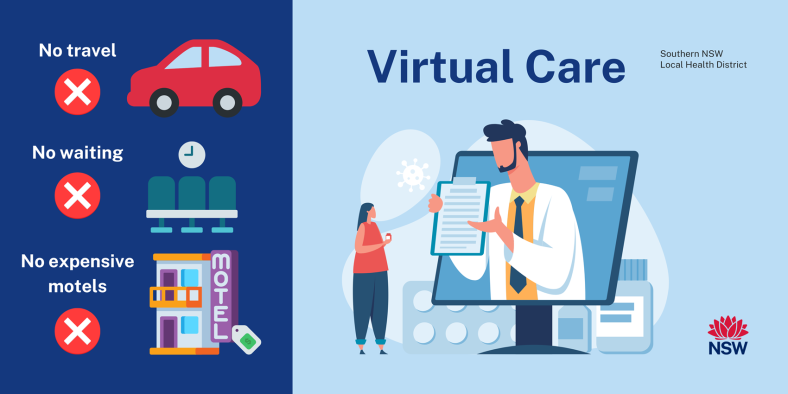
Virtual care helps patients and families:
- get services from home, the hospital, or a community centre, virtually
- cut down on travel while still getting high-quality care
- enjoy more convenience and choices
- save time and money on travel
- access services more fairly and promptly for better ongoing care
- reach specialist services that might not be available nearby
- stay connected with loved ones through technology.
1:51
Virtual care in NSW
Discover how virtual care works, and how it can help you.
How virtual care helps you
Living far from big cities can make healthcare challenging with long travel distances and wait times. Virtual care eases this stress. Using everyday technology, it supports in-person visits, reducing travel and stress for families. It's a breakthrough for rural healthcare.
Different types of virtual care
Telephone and video consultations
You can use everyday devices like a telephone, smartphone, tablet, or computer for virtual healthcare. Videoconferencing platforms, like MyVirtualCare (myVC), Pexip, and Microsoft Teams, are safe and secure. To join video consultations, you'll need a stable internet connection or mobile data.
People often use both virtual care and in-person appointments for their healthcare. Discuss with your healthcare provider to find the best options for you. You can choose how to see your healthcare professional based on your needs, and it can vary from appointment to appointment.
Remote monitoring
Remote monitoring uses technology to collect and send your medical and healthcare data to an app, device, or service. Remote monitoring equipment or devices can be used to measure:
- blood glucose
- blood pressure
- heart rate and heart rhythm (pacemaker)
- respiratory function
- oxygen saturation
- body temperature
- body weight, and more.
Computer and mobile requirements
Computer
- internet connection with access to data
- Google Chrome internet browser
- integrated or USB camera
- headset or speaker/microphone.
Tablet
- internet connection with access to data (a 30-minute video call uses approximately 400MB)
- Google Chrome or telehealth platform app (consult with your health service provider)
- integrated or USB camera
- headphones with a microphone or enabled speaker/microphone.
Smart Phone
- internet connection with access to data (a 30-minute video call uses approximately 400MB)
- Google Chrome or telehealth platform app (Discuss with your health service provider)
- integrated or USB camera
- headphones with a microphone or enabled speaker/microphone.
Note: Always consider your own privacy and the privacy of others when using video, speakers, or microphones in public places.
Available myVirtualCare services
Here's a list of services using myVirtualCare in Southern NSW LHD. Contact your health service provider for more information.
| Aboriginal Health | Oral Health Service |
| Adult Community Mental Health | Osteoarthritis Chronic Care Program (OACCP) |
| Alcohol and Other Drugs | Paediatric Services |
| Brain and Spinal Cord Injury Service | Palliative Care |
| Child and Adolescent Mental Health Services (CAMHS) | Parkinson's Nurse Specialist Service |
| Cancer Services | Physiotherapy |
| Cardiac Rehabilitation | Planned Care for Better Health |
| Child and Family | Rehabilitation |
| Child and Family - New Street Service | Rehabilitation Medicine |
| Child, Infant and Family Tertiary Services (CIFTS) | Renal Medicine |
| Diabetes | Residential Aged Care |
| Fracture Clinic | Rural Counsellors |
| Genetics | Sexual Health and Hepatitis Service |
| Geriatric Nurse Outreach | Social Work |
| Got-IT (Getting On Track In Time) | Speech Therapy / Pathology |
| Integrated Violence Abuse and Neglect (IVANS) | Transitional Aged Care Program (TACP) |
| My Aged Care Assessment Service | Tuberculosis Service |
| Nutrition and Dietetics | Women's Health In the North (WHIN) |
| Occupational Therapy | Wound Care |
| Older Persons Mental Health |
How to book an appointment
To schedule a virtual care appointment, talk to your local health provider. They can help decide if it's suitable for you and assist in making the booking.
Contact us
| Contact | Contact information |
|---|---|
| Administration Contact | Phone: 1800 999 880 |
| Virtual Care and Telehealth Manager | Phone: 0403 925 883 |
Find a virtual care service
Use our Service Directory to find a health service near you.