

About the District
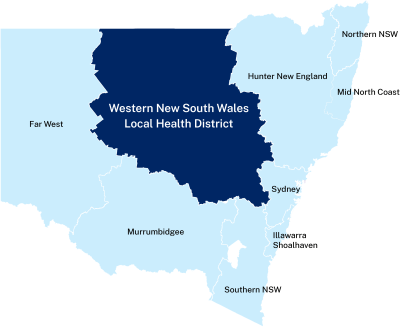
Covering a geographic area bigger than Victoria, our Local Health District is the largest of all 15 in the state.
Western NSW includes some of the most remote, and most vulnerable communities in the state.
Across 2022-2023 our populations and communities continued to grow, move and age, in line with forecast trends.
Our communities also continued to be more heavily impacted by risky health and lifestyle factors than people across the rest of the state.
- 246, 676 square kilometres, approximately one third of the state's land area
- 22 Local Government Areas, 7 classified as remote or very remote
- 284, 285 people, approximately 3.6% of the state's population
- 41, 339 identify as First Nations people, or 14.5% of our population
- 80.5 years life expectancy at birth, compared to NSW average of 83.3
- 38 years median age, compared to NSW average of 36
- 2 births per woman, compared to NSW average of 1.5
- 5.5% projected population increase by 2030
- 44% projected population increase in people aged 70 and over between 2021 and 2041
- 83% of our population currently lives south of Gilgandra, forecast to increase to 90% in the next 15 years
- Remote communities forecast to halve in size in the next year 15 years, while regional cities grow substantially
- 18% of adults smoke daily, compared to 12% across NSW
- 57% partake in sufficient physical activity levels, compared to 63% across NSW
- 38% of adults partake in risky alcohol behaviour, compared to 34% across NSW
- 92% of women receive antenatal care by 20 weeks gestation, compared to 93% across NSW
- 14% of children are developmentally vulnerable in 2 or more domains, compared to 10% across NSW
- 69% of adults are overweight or obese, compared to 58% across NSW
- The rate of people presenting to emergency departments as a result of mental illness is 54% higher than the rest of NSW
- Geographic barriers associated with population spread and uneven population growth
- Vulnerable communities needing to travel to access healthcare but not always having the infrastructure, or social or financial resources to easily do so
- Continual increase in demand for healthcare services, and the projected future demand for healthcare services
- Building a strong and sustainable workforce to support health services and communities into the future
- Ongoing difficulties recruiting and retaining the required workforce, and supporting remote communities with increasingly limited access to GPs and primary care
- Adaptation to, and expansion of innovative ways of delivering healthcare such as virtual care services
- Caring for an increasing ageing population with complex health needs
- Shrinking populations in rural and remote communities, and rapidly increasing populations in larger regional cities and towns
- Financial limitations impacting the response to service demands of communities
- Changing environment and environmental disasters such as drought, floods and bushfire
- 8,674 total staff:
- 42.3% nursing
- 15.1% enabling
- 11.7% medical
- 6.2% allied health
- 23.9% other
- 1 in 12 staff identify as Aboriginal or Torres Strait Islander
- 56% permanent staff
Activity and performance
Facing enormous demand, our District remained among the highest performing in the state across 2022-2023.
Key measures like emergency department presentations, admissions and elective surgeries were higher than rates across the rest of the state.
Our dedicated workforce once again rose to those challenges to provide innovate, safe and high-quality care for our communities.
Hospital activity
Our hospitals and health facilities continued to experience significant, sustained demand throughout 2022-2023. This data helps us to assess our service delivery, and to forecast future demand.
Patient experience surveys
More than 25, 000 people responded to surveys about their experiences while receiving care in our facilities in 2022-2023. Their responses show us what we are doing well, but also where we can improve.
Achievements and initiatives
In 2022-2023, our District accomplished a number of important achievements and made a range of enhancements to improve our services, facilities, culture and access to care to ensure we meet the needs of our patients, staff and communities now and into the future.
Reconciliation Action Plan
In May 2023, we launched our second Reconciliation Plan, demonstrating our ongoing commitment to improving the health of First Nations people.

Meaningful Engagement Strategy
We implemented our first Meaningful Engagement Strategy in the last 12 months, to reshape the way we engage and work with our communities.

- Delivered the state's first Remote Mobile CT Service, significantly improving access to the latest diagnostic imaging technology in remote areas of the District.
- Opened the Centre for Rural Education, Simulation and Training Simulation Centre at Wellington, strengthening staff training and development opportunities locally.
- Formally opened Bathurst Hospital's new MRI suite, improving access to diagnostic imaging technology for the local and surrounding communities.
- Established and progressed the Western NSW Clinical Trial Support Unit, allowing patients to access clinical trials previously only available in metropolitan areas.
- Completed refurbishments of five palliative care projects in rural areas of the District, creating home-like environments and improving comfort for patients and their families.
- Enhanced cancer care services at Orange by establishing a new, state-of-the-art radiotherapy machine to make treatments more precise and streamlined.
- Established a new Dementia Awareness and Support Team to support people living with dementia and their families, and to assist navigation of care pathways.
- Supported Health Infrastructure to significantly progress the $200 million Bathurst Hospital Redevelopment including the release of the Master Plan and Concept Design.
- Supported Health Infrastructure to release the Concept and Schematic designs for the $110.2 million Cowra Hospital Redevelopment, following the announcement of an additional $40 million the 2023-23 NSW Budget.
- Progressed planning and construction on Key Health Worker Accommodation projects at Warren, Collarenebri, Walgett, Baradine, Condobolin, Tullamore, Narromine, Trundle and Wellington, completing and delivering several.
- Secured the preferred site for, and progressed planning on the Dubbo Residential Rehabilitation Centre, which will support people in the community to overcome addiction.
- Supported Health Infrastructure to progress the Blayney Multipurpose Service Redevelopment, which is currently out for main works tender.
- Progressed the Canowindra HealthOne project, with redevelopment planning to begin following the announcement of an additional $2.3 million in the 2023-24 NSW Budget.
- Continued and progressed planning on Orange Hospital's solar project, the second largest solar PV installation in any government facility in NSW.
- Supported Health Infrastructure to complete the $30 million Dubbo Hospital carpark project, to support patients and staff following the $306.3 million Dubbo Hospital Redevelopment.
- Appointed the District's first Chief Medical Officer. Professor Mark Arnold began in the role in January 2023, putting an emphasis on clinical practice standards and long-term development of the medical workforce.
- Continued leading in the roll-out of the NSW Government's Rural Health Workforce Incentive Scheme, to support the recruitment and retention of staff to hard-to-fill and critical roles.
- Implemented the District's first Allied Health Rural Graduate Program, to support 15 recently-graduated professionals to consolidate and grow skills across a range of clinical areas.
- Increased the number of New Graduate Nurse positions available in the District in 2023 and welcomed record numbers, with a priority focus on recruiting to positions at small, rural facilities.
- Developed and established plan for all New Graduate Nurses to be employed on a permanent basis from 2024 onward.
- Launched our District's first Environmental Sustainability Strategy (PDF 3.8MB), to outline roadmap towards best practices in environmental sustainability in health service delivery.
Our Awards
- The 2023 WNSWLHD Nursing and Midwifery Awards were announced in May this year. Recipients are nominated for the state-wide awards.
- The 2022 WNSWLHD Awards were celebrated at an event in September last year. The 2023 Awards were announced in August this year.
- The 2022 WNSWLHD Allied Health Awards were announced late last year. Recipients are nominated for the state-wide awards.
NSW Health Awards
- The Welcome Baby to Bourke Ceremony was announced as one of three finalists for the Excellence in Aboriginal Healthcare Award, in the 2023 NSW Health Awards.
- Garima Nepal, from Coonabarabran Health Service, was announced as a finalist in the New to Practice Nurse/Midwife of the Year Award, in the 2023 NSW Health Excellence in Nursing and Midwifery Awards.
- Stacey Denny, from Gilgandra Multipurpose Service, was announced as the joint winner of the New to Practice Nurse/Midwife of the Year in the 2022 NSW Health Excellence in Nursing and Midwifery Awards.
NSW Premier's Awards
- The District's Virtual Rural Generalist Service (VRGS) team was announced as the winner of the 2022 NSW Premier's Award for Excellence in Digital Innovation.
Other notable Award winners
- Paediatric nurse Dominique Spork was announced as the winner of the Humpty Dumpty Foundation's Michelle Beets Award for Inspirational Paediatric Care in 2022.
- Former Executive Director of Aboriginal Health and Wellbeing Donna Stanley was announced as the winner of the University of NSW's 2022 Australian Mental Health Aboriginal or Torres Strait Islander Prize.
Our Annual Public Meeting
The end of each financial year is a chance for our District to join our community at our Annual Public Meeting (APM) to reflect on the last 12 months, which you can revisit on our Youtube channel.
Alongside our APM, this year we also held our first Community Conference to connect with the people of Western NSW on a more meaningful level.