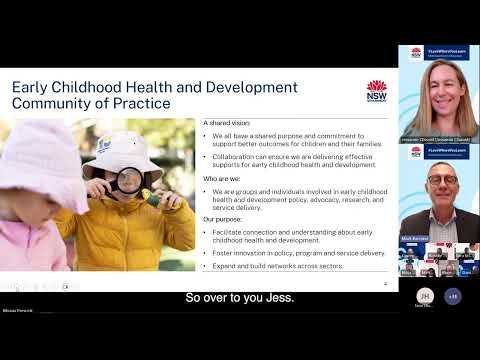
Mark Barraket: Good afternoon everyone. It's great to be able to meet you all online virtually. Can I begin by acknowledging country and the different lands upon which we are all joining from? I'm in the Department of Education's George Street office on Gadigal land, about one kilometre from the Sydney Opera House, which is known as Bennelong Point. And I recently learned that that area was not always connected, the Point was not always connected to the mainland. During high tides Bennelong Point would become a bit of an island and local Aboriginal women would collect oysters from around that location. Can I pay my respects to the Elders past, present and emerging and extend a warm welcome to Aboriginal and non-Aboriginal colleagues that are joining us for this inaugural Community to practice. Colleagues, for those of you who don't know me, I'm currently the Acting Deputy Secretary, Early Childhood Outcomes with the New South Wales Department of Education. And I'm really pleased to be able to welcome you here today for this Early Childhood Health and Development Community of Practice, our first one. A bit about me. I've got a background as a primary school teacher, and I've had a really privileged career with the Department of Education over 30 plus years. I'm giving my age away there. Started as a teacher in Southwestern Sydney, had 2 principalships at Chullora Public School and Croydon Public School, 2 fantastic schools, very different. And then have had a great career as a Senior Officer within the Department of Education. And one of the reasons why I'm really interested in this work around early childhood health and development is because as a teacher and as a principal, I saw firsthand the importance and the impact that this work can have. And if I can just share with you a story about a student who I worked with when I was principal. My first principalship at Chullora in the Bankstown area, there was a family that came to the school, they wanted to enrol their year one son; he was at a another school in the local area. He had quite a number of suspensions and the family had decided the school he was at was just not working out for their son. So through kindergarten he had 22 suspensions. This was a young man that family were immigrants. He did attend preschool and he was from a non-English speaking background. So that was pretty sobering to have a young child constantly suspended. I worked with the school where the student was currently enrolled and they were happy to say, "Take him. He's, you know, do what you can with him, our strategies have not worked." I had a fantastic staff at the school, we engaged them, we engaged the local health services, the local learning and wellbeing teams within the Department of Education. And what we discovered was that this young man was deaf, was profoundly deaf. And it was not picked up in preschool, it was not picked up in kindergarten, and that of course led to his suspensions, his disengagement in education. What struck me was, when we worked out what was going on for this young person, how quickly he started to learn. He was one of the brightest young students I've worked with, quite charismatic, picked up speech and how to talk very quickly, how to read very quickly. But I often reflect on what would the pathway for this young student have been if at a much earlier age, at a much earlier age, health professionals, the family, preschool, and the school that he was at were able to pick up that he had a very significant hearing impediment. So that points to the importance of the work that we do to support early childhood health and development. That's just one example. One example that I can give you amongst many where I think young children have been disadvantaged, have not had the best start in life and learning because their circumstance, their situation, and the system that is meant to support them as they start their life and learning journey has not picked up on a health or development need for that child. So I know that this is new for you, that as practitioners that support childhood health and development, that you understand that the evidence is clear that the early years of a child's life are so important: they are foundational. That time from pregnancy to when a child starts school is vital and can be instrumental in predicting what their life outcomes are going to be and can have a significant impact for years to come for that child's life as I've just illustrated through the story of that young man that I had the privilege of working with. There's a long way to go though, I'm sure that across New South Wales there are other children just like the one that I've mentioned that have got developmental and health issues that might be slipping through the cracks. And I think that this forum is a really good way for us to come together to share intelligence, to look at exemplary practice and to have a collective commitment to promote better early childhood health and development outcomes. So I'm delighted that everybody has agreed to be here today to participate in this. I know that there are many government agencies right across New South Wales that are involved in the development of policy services and programs to support children and families, and there is exceptional work being done in this space. So from here in the Department of Education to our colleagues in health, Department of Communities and Justice and other agencies that are here, I'm really heartened that we can come together to have a conversation, particularly around the reforms that we are seeing and what the future direction looks like so that we can deliver better outcomes for children and their families. I think you'd agree that this kind of collaboration can really be at the centre of delivering effective supports to improve early childhood health and development outcomes for our youngest people in New South Wales. And collaboration can be hard, but it can also be incredibly rewarding. So thank you for coming along. I would encourage you all to actively participate in this process. If you've got things that you wanna bring forward and add to the agenda; if you've got topics that you think need to be discussed, please send them through to us and we'll make sure that in future meetings we will be able to discuss those things, to share ideas and to collaborate. So the vision behind this is that it is an open forum for discussion to share expertise. And we're hoping to get together roughly every 6 months so that we can have the conversations that we need to have and to ensure that this Community of Practice will be really effective and meaningful for everybody involved. Can I thank you the your time, and I look forward to hearing more about this Community of Practice, as I'm sure it's gonna take shape and flourish, hopefully for many years to come. I'm going to introduce Jess Clissold, who's a great colleague of mine from within the Department of Education. She's gonna be the facilitator for this Community of Practice. Jess is our Acting Executive Director for Early Childhood Strategy and Partnerships and she's gonna be steering this meeting and I'm looking forward to hearing about the outcomes. So over to you Jess. And thank you once again everybody.
Jessamin Clissold: Thank you very much, Mark. Thank you very much for that introduction and for sharing your personal story, which I think highlights why we're all here today. I'd also like to begin by acknowledging that we are all joining from Aboriginal lands today wherever we are, I am coming to you from the land of the Gadigal and Wangal peoples, and I'd like to pay my respect to Elders past and present and extend that respect to the Elders of all of the many Aboriginal lands from which we are coming today. I'd also like to extend that respect to Aboriginal and Torres Strait Islander people who are participating today and to our wonderful colleagues that we work with alongside every day. So I'm Jess Clissold, I'm Acting Executive Director, Early Childhood Strategy and Partnerships, as Mark said, I have been in the Department of Education for nearly 5 years, and before that I was in New South Wales Health where I worked with many of the people that you'll be hearing from today way back on the First 2,000 Days initiative. So this is a matter that's really, really close to my heart and it's been so fantastic to see it grow and where it's gotten to today. So I would like to reiterate Mark's warm welcome to everyone participating in this inaugural Early Childhood Health and Development Community of Practice. It's really exciting to be able to bring together partners from across many sectors, all with a passion and shared commitment to supporting our children, families, and communities across New South Wales. So this will be familiar to many of you, but I thought I would just give a quick outline. Since 2020 in recognition that no single system or agency can drive the level of improvement we really need to increase the number of New South Wales children who are developmentally on track. New South Wales agencies involved in supporting children and families have partnered together to deliver a holistic approach to improving child health and development outcomes. That's known as Brighter Beginnings and it's a coordinated cross-government collaboration bringing together 7 agencies across New South Wales Government, and they include; New South Wales Health, Department of Communities and Justice, Department of Customer Service, Education, Department of Regional New South Wales, Multicultural New South Wales, Aboriginal Affairs and the Cabinet Office. And I'd like to extend a really warm thank you for the wonderful collaboration across those agencies. Brighter Beginnings builds on New South Wales Health's First 2,000 Days Framework from all those many years ago with my wonderful health colleagues. The framework is a strategic document outlining the importance of the first 2,000 days of a child's life and places emphasis on working in partnership to deliver what children and families need to thrive from conception all the way through to school. So we know that there's more work to be done in early childhood health and development. The 2021 Australian Early Development Census, which is a national population-based measure of how Australian children have developed by the time they start school, showed that 44.5% of New South Wales children are not on track in all 5 domains at the time they start school. And that's the lowest level recorded in New South Wales since the AEDC was first introduced in 2009. And we know that there's an even bigger gap for some of our children, including our Aboriginal and Torres Strait Islander children. So we all know the importance across agency collaboration, which is essential to improving outcomes for all children and their families, but in particular our most vulnerable cohorts of the population. We know for sustainable change we need to focus on systems, coordination of our services, and the way in which we work together. To date, Brighter Beginnings has provided a reinvigorated platform for all agencies involved and our key stakeholders to remain committed and focused on working together to improve child health and development outcomes for children. So this cross-agency partnership has 3 key objectives; increasing universal access to education, health and community services; providing targeted early intervention to families experiencing disadvantage; improving families experience and outcomes in the interaction with government; and raising awareness and understanding of the importance of the time from pregnancy to primary school on a child's development. By prioritising universal access with targeted delivery models, Brighter Beginnings provides flexible cross-agency approaches to support children who face barriers to services and makes connections between government services to ensure that children don't slip through the gaps, like the child that Mark was talking about. These groups include Aboriginal and Torres Strait Islander children, children and or parents with disabilities, children from low socioeconomic backgrounds, children living in regional, rural and remote New South Wales and cross border communities, and families from culturally and linguistically diverse or CALD backgrounds. Agency partners are currently focused on the delivery of the investment made in the 22/23 New South Wales budget to deliver a suite of early childhood health and development initiatives. These initiatives build on existing world-leading programs. They're evidence-based and are mapped to children's needs across the first 2,000 days continuum. And they include; Pregnancy, Family, Conferencing for obviously the pregnancy stage. Conferencing services to provide early family support co-led by New South Wales Health and Department of Communities and Justice. There's a statewide expansion of pregnancy family conferencing underway with a stage rollout planned. So it's very exciting. For the pregnancy to age 2 cohort, we have Sustaining New South Wales Families. That's a nurse-led sustained health home visiting program for families living in areas of socioeconomic disadvantage, and it's led by New South Wales Health. Funding for this program allows for a scale up of existing services and model, and the sites across the state with an additional 8 announced in June, 2023. A pilot model for more vulnerable and complex families called Sustaining New South Wales Families Plus, or SNF Plus; and a trial model for families with a lower level of distress and or higher level of supports, so SNF Lite. From birth to age 5, we have the Digital Baby Book Initiative. That's a digital version of the current paper-based baby book, which you might know as the Blue Book, might have on your bookshelf like me, led by New South Wales Health. That's a consumer focused and owned app that will be initially delivered with iterative updates based on user feedback. And we have an expansion of Aboriginal Child and Family Centres, or ACFCs, and that will provide benefits for children and families with children aged birth to age 8. That's an expansion of culturally safe services and supports for Aboriginal families led by the Department of Communities and Justice and operated by Aboriginal community-controlled organisations. There are currently 9 of these Aboriginal community and family centres, and 6 more will be established, led by Department of Communities and Justice. We also have health and development checks in preschools. So that's for 4-year-olds in preschool settings and it delivers health and development checks so that you're gonna hear a bit more about that program in a minute. But that is situated in department preschools, and long day care services and community preschools and is a project co-led by New South Wales Health and the Department of Education. Brighter Beginnings also supports the New South Wales Government's commitment to achieving the Closing the Gap Target 4, and that is that by 2031 New South Wales aims to have increased the proportion of Aboriginal and Torres Strait Islander children assessed as developmentally on track in all 5 domains to 55%. So with New South Wales agencies working together, there is real opportunity to streamline and improve parent and carer experiences to drive greater engagement and participation in services and supports. We know that Brighter Beginnings will only reach its full potential if agencies work in true partnership with each other, and frontline professionals, researchers, communities and families to share evidence, knowledge and expertise and build on each other's strengths. So today is our first Community of Practice, and as it's our first one, our first item today will be a deep dive into the recently announced initiative of Health and Development Checks rolled out in early childhood education and care centres. This is a really exciting initiative. As I mentioned, it's a collaboration between education and health to create a practical solution to increase the number of children receiving a health and development check. And maybe if it had been in place, it might've identified the issues that Mark was discussing earlier for that child. In this deep dive, we'll explore the learnings and insights that have been gained from this ongoing collaboration. The second item we're going to talk about today in the Community of Practice is a panel discussion on how we can best support Aboriginal and Torres Strait Islander children and families in the early years. This panel will make, will include representatives from the Secretariat of National Aboriginal and Islander childcare, or SNAICC, and the Department of Communities and Justice and Aboriginal Affairs. Finally, as we close out the session, we'll be asking what topics you'd like to hear on next time so that that can inform the agenda of future Early Child Health and Development Community of Practice forums. So we'll now move to our first item, which will be co-presented by the Ministry of Health, April Deering and the Department of Education's Maja O'Dell. April is the Associate Director and Health Lead for Brighter Beginnings, the first 2,000 days of life in New South Wales Health. And Maja O'Dell is the Manager of the Health and Development Checks in the Early Childhood Outcomes Division in New South Wales Department of Education. So April and Maja, over to you.
Maja O’Dell: Thanks Jess. We're just sorting the audio in the room. Thanks Jess. And it's really exciting to be here today and I think it's really great to be co-presenting this with April 'cause it really is a demonstration of how our 2 agencies have come together from rolling out to the program to actually presenting on it together. So that's really, really exciting to be here today. Before I start, I just wanted to acknowledge that I'm coming from the homelands of the Dharug people, and I wanted to pay my respect to Elders past, present. And I wanted to extend my respect to all Aboriginal people and Torres Strait Islanders people on this call today. Pay my respect and acknowledge all of the different lands that everyone is coming from across the state on this call today. So Health and Development Checks in ECEC is, as Jess mentioned, a partnership between New South Wales Health and DOE. We know that many children in New South Wales are not getting their 4-year-old health and development checks. As Jess pointed out, that equates to about 2 in 5 children also not starting school developmentally on track. Regular health and development checks are important to give families those crucial insights into how their children are tracking before they start school, and to ensure children and families are getting the support they need as soon as possible. The Health and Development Check in Early Childhood Education program builds on existing services where parents and carers can access their child's health and development checks such as their local doctor or their child and family health nurse or their local AMS. How did we get here? So we've spent quite a long time designing this program. We've had numerous consultations with both the health and education sector and there's probably people on this call today who have participated in some of those workshops, or our ECE connects, or our various roadshows that we've done around the state. We've consulted with the sector, with families, with Aboriginal and Torres Strait Islander communities. There we've held sector readiness surveys, done co-design workshops, held family voice workshops, started off with a research report. So there's quite a lot of work that's come to this point. The program has now moved from the design phase into the delivery phase. We've taken what we've learned from these consultations and developed a model that can be tailored to our local needs. So that's where we are now. As you can see there in our phase, phase one commencing in 6 local health districts. And April in a second is going to go through a little bit more detail about where those districts are and what that looks like. And so just back, slide back for a second, sorry. So while we're progressing the rollout, we're also looking to the future to develop tools such as our reflective tool to improve cultural safety, which I'll discuss in a little bit more detail in a later slide. We're working on some funding to help out ECE services participate in the HDC program. And that's a good example of what we've heard through all of our consultation and some of the support we'll be rolling out to the sector. And we're also working on some training and development to help both our ECE educators and our LHD staff to help provide that specific support needed to the children to support them after the findings of the check. Next slide please. Over to April.
April Deering: Thanks Maja. Building on, well first I'd like to build on Maja's acknowledgement of country and say that I'm coming to you from Cammeraygal land today and it is beautiful here. So hope everyone else is having a lovely day as well. Building on all of that consultation that Maja has talked about, we are rolling out the program now in initially 6 local health districts that you can see there with beautiful coloured stars. So the first 6 were Illawarra Shoalhaven, Hunter New England, Mid North Coast, Nepean Blue Mountains, Southeastern Sydney and Southwestern Sydney, with those great green stars followed by the yellow stars that are coming online now. So the implementation will occur progressively. Those that aren't offering checks in centres right now mostly are already taking appointments for later this year or early next year. So we really are seeing a concerted rollout across the state that is happening now and into next year. The way that it happens locally is that districts are in contact with a small number of early childhood education centres to start with. Each district is at a slightly different stage of implementation. And the number of services engaged in the health and development checks will build on the foundation that is there now and increase until the program is offered in all early childhood education and care centres. So that's going pretty well at the moment. As the program is building, the project team will be doing site visits, going out into early childhood education services so that we have an opportunity for both health and education services to share their feedback, their insights, and allow us to refine the program as we go building on that experience. It really is an iterative process where we all learn from each other and we do meet regularly in statewide meetings to discuss that. I think we're ready for the next slide please, thanks. So the health and development checks, which are available to 4-year-olds who attend participating early childhood education centres include a number of things. I should have said that the centres that it's rolling out to include the Department of Education preschools, community preschools, and long day care centres. It's free program, it's opt-in for families and it is opt-in for early childhood education services. So the checks in the services include health professionals looking at children's listening and talking skills, their social skills and behaviour, their gross and fine motor skills, their learning, thinking and problem solving skills and how their bodies are growing. And the checks only happen with parental consent and if parents consent, the health professionals and educators can also share information on the developmental assessments that have been done. I think, oh yes, I continue on this slide. So local health district teams do contact services and are progressively contacting more services to let them know that they're available to offer the health and development checks, and they work with the services to find a time that's convenient for them to come out and offer those checks on site. Teachers and educators are asked to assist with, first of all, collecting the consents because, of course, they cannot hand over parent details to Health without consent from the parent in the first place. But also with preparing families and children for the check when it comes in. Health professionals complete the check and provide families with a report after the check and that will include referrals where that's required. Additional support and training, including some of those resources that Maja was talking about before, and participation funding will be available to early childhood education and care services soon. Information for families will also be available to support early childhood education centres and services with fulfilling that role of preparing families and children. Local reform and commissioning team will also be offering local implementation support as the program rolls out.
Maja O’Dell: Thanks April.
April Deering: My pleasure. Over to you.
Maja O’Dell: So it's been really important. Well it is really important for the program success and just to ensure that we are making sure that we take a culturally safe approach and an approach that makes families feel safe to participate in health and development checks. It's about creating an environment where children feel safe and valued and respected and ensuring a culturally safe approach and a safe approach for all families and ECE services involves building relationships with families and community, which includes taking the time to get to know their families and their culture and to build that trust. Making sure families are involved in decision making about their children's care. Being inclusive, using inclusive language and practices and celebrating diversity of cultures and backgrounds represented in the ECEC services. So we've just highlighted there some of the things that we are doing to make sure that this check is delivered in that safe way and in a culturally safe way. So accessing services that have private spaces available, families and friends, being able to be present, family and support members being able to be present during the check. Families being provided with results and where appropriate, given some suggestions or activities to support their children. EC services in the future will be provided where appropriate with enrichment activities that can support certain cohorts of children. So this ties in back to what we were talking about developing supports for ECE services in as this project rolls out, and ensuring that children are referred to appropriate health support services. And so one example there is the case of our Aboriginal children and making sure that they're being referred in a culturally appropriate way to culturally appropriate services. So one of the things that we're doing particularly to ensure their safety is we're building a reflective tool to ensure a culturally safe approach. We're building this as an interactive reflective tool designed to help ECE providers reflect on their own practices and identify areas where they could improve their cultural safety in supporting all families through the health and development check process. And that's something that is being developed at the moment and something we are hoping to have a bit more information as we move into the next phase of our implementation of this program. If I can just move to the next slide please. So we thought some insights, sharing some insights about some successes that we've had so far in the program and some things that we're learning along the way. Even though we've only really sort of been in this rollout phase for, first rollout phase for a few months, we've learned quite a lot already and hoping to learn quite a lot more on this journey and really keep refining this model. As April mentioned, it's really, for us, it's an iterative process. We don't just sort of roll out a program like this and then walk away and hope that it just works. It's really paying attention to what's landing, where it's working, areas where it's working really well and what's contributing to that and sort of areas where it's not. And so since we've kicked off, we've produced FAQs, some of those are on our website. We'll share some links at the end. Posters, FAQs for families and educators, we've been getting quite a lot of engagement with services. It says here over 70 but it's probably gone higher since these slides were produced. These numbers seem to be going up in real time. So a lot of services are reaching out to us asking how they can get involved. We're seeing a lot of excitement among, in the sector. And so it's just about having to find that balance between that excitement building and making sure that we're implementing in an appropriate way. We started to build really good relationships on the ground with our local reform and commissioning team, which is our internal early childhood outcomes team that is on the ground and working with the services on the ground. We are getting all our promotional material out there and we're building strong relationships between our health teams and our ECO teams and our commissioning teams. April, did you wanna reflect on any learnings or any opportunities? If we can go back, I thought this might be a good chance to maybe really understand where, with how some of this relationship is working.
April Deering: I think the partnership part of it is really important and I think we're learning more about that all the time and how that works in practice. I think for early childhood education centres there are a lot of questions about how that partnership will work and we will be learning more about it as we go. As you said Maja, we have learned so much from the process so far and we're really looking forward to learning more and tweaking the way that we do things based on that. And we know that it will continue to get stronger and be something that can be delivered in a way that's comfortable for everyone involved as we go forward. It's looking really good so far and we're very excited about what the future's going to look like and how much of a difference it will make to a lot of children.
Jessamin Clissold: Thank you so much Maja and April, that's super exciting to hear about that partnership work and how it seems to be rapidly growing and expanding and how it's being received. We are a couple of minutes ahead of time, which is amazing. There aren't any questions in the Q&A function, but if anyone wants to pop a question in there, I can read it out to April and Maja. So I'll just give you a moment otherwise we can move on to our next item. Appreciate people might also wanna have a think about all that information and what they've just heard. And you do have the email address to send questions too as well.
Maja O’Dell: We've also popped a QR code there. We're trying to be technologically savvy, and that will hopefully take you to our landing page which has a lot more information about the checks, about the currently participating LHDs, how to get in touch with the LHDs. It's got our email on there and it's just got some downloadable yep, downloadable resources including those FAQs I mentioned and posters for services that can be printed and used. So yeah, have a scan of that QR code and it'll take you straight to that website.
Jessamin Clissold: Thanks Maja, that's fantastic and definitely more high tech than I am. We've just got one question that's come in that says, "For families ineligible for Medicare, will they still have access to the screening?" I think that's probably so, April.
Maja O’Dell: Yes, the answer to that is yes.
April Deering: Yes. So they will have access to the screening. That's right. They will need to consider any referrals because of course those, if they're ineligible for Medicare will probably need to be paid for. So there are not a lot of families now that are not eligible for Medicare unless they're on particular visas. But it is something we have considered and definitely the checks are there for all of the children who are eligible in those centres.
Jessamin Clissold: Thank you. Fabulous. Just checking there is one more question here. "What does engagement and consultation look like for our ACCOs, sorry, our Aboriginal Community Controlled Organisations providing early childhood education and care?"
Maja O’Dell: So great, great question. So we've been working closely with our Aboriginal Outcomes team and we've been working closely trying to make sure those relationships continue to be built on. We will definitely be coming out and having those discussions in the coming period that we are doing all of our testing and learning.
Lauren Anderson: I'll jump in here. Key with our ACCOs, especially with our EC ACCOs, is that many of them have been doing health and development checks in their services for up to 20 years as well. So it's not only a great opportunity for us to get out there and see how we can further support those existing programs, but also learn from them in terms of, especially for that cultural safe approach. How have they been operating, how can we learn, how can we take all the stuff that they've been doing and think about how you'd apply that in say mainstream universal preschool in Western Sydney that might have a high population of Aboriginal kids. So but continued and ongoing consultation and collaboration really with our ACCOs.
Jessamin Clissold: Thanks Lauren. "We have a large cohort of children who are ineligible for Medicare and also ineligible for NDIS due to visa constraints. What will be the process for these families after screening?" So I guess the question is, you've said they're eligible for the health and development checks, but how will they access services afterwards?
April Deering: Yeah, so they will access those services the way they do for any other services that they are currently accessing. So some of them will have health insurance that will assist, some won't. And if they want to access public services, those will come at a cost. So that's something that we'll have to be looked at quite carefully and worked on with each of those families if it's needed.
Jessamin Clissold: Great, thank you so much Maja and April. I think we can say thank you and move on to the next topic and leave you to resolve any Optus or otherwise internet issues.
April Deering: Thanks very much Jess.
Jessamin Clissold: But thanks very much for a great presentation. I'm going to pass over to my wonderful colleague Kelly Humphrey now to lead a panel on supporting Aboriginal and Torres Strait Islander children and families in the early years.
Kelly Humphrey: Thanks for having us this afternoon. For those of you who don't know me, I'm Kelly Humphrey. I have the pleasure of being the Director for Aboriginal and Torres Strait Islander Early Education and Care, and I'm joining today from the land of the Burramattagal people. And I'd like to acknowledge the Elders from the time before, from the time of now and for the reason we're all here on the screen today for the time that we'll be. And I have the absolute pleasure of hosting this esteemed panel today as we discuss supporting Aboriginal Torres Strait Islander children and families in the early years. I will be joined by some pretty deadly women on the screen. I think we might even be spotlighted so our faces will look big and I'm gonna block the screen at that point so I don't have to stare at myself. We have 3 women joining us, but I just have to say Lisa Madden who's the Director of Health and Government Relations at Aboriginal Affairs is running a little bit behind schedule today. So she may not be joining us exactly as we kick off. But we also have Jayde Ward, who's the Director of Care and House and Transforming Aboriginal Outcomes from the Department of Communities and Justice and our good friend Renee Moore, who's the Director of SNAICC Early Years Support in New South Wales. And for those who aren't aware, SNAICC was appointed as the sector strengthening partner for ECEC services with the Department of Education earlier this year. And I was thinking about this powerhouse of deadly women in the lead up to this panel and I was like, "Oh, if I could choose a song that could showcase this group, what would it be?" And I started off by thinking, Well it's that song, you know, ♪ Sisters are doing it by themselves ♪ by the eurythmics. But we aren't doing it by ourselves, we are doing it in a collaboration along with communities and with our families and with our government agencies. So that really doesn't sit well as the song. So then it came to me, I was like, it's, 'My People My People' by the late Chris Phillips. Now if you don't know that song, get it on Spotify, it's a Koori Murri Goori classic. But the third verse actually shares the lyrics of: "Aboriginal people across this land don't forget what we're fighting for. Our children is our future nothing will deny us to our next generation. They keep us strong to linger on with our legendary dancers and our cultural songs. My people, my people, Aboriginal people, don't forget what we're fighting for." So with that, please help me welcome Jayde and Renee who are on the screen, and Lisa who will join us shortly to kick off to hear all of their wonderful wisdom. I'm very excited for this 'cause I get to ask the questions and they get to share their learnings. And the first question I'm gonna throw out to the panel today is, ladies, what generational impact could be seen if Aboriginal children and families experience positive interactions in the early childhood health and development services that they may be accessing? And I dunno who's gonna kick that one off, but you get Renee's off mute, go Renee.
Renee Moore: Happy to jump in. Yaama (hello), sorry everyone, I'm coming to you guys on my phone. I'm having technical difficulties and I've also got some neighbour's dogs. But look, for those of you who don't know me, I'm a Gomeroi woman and I'm coming today from beautiful Yuin Saltwater Country. And that's a really great question Kel. I mean, I think positive interactions including cultural responsiveness, you know, we know that that then changes the long-term trajectory where we're seeing, you know, less incarceration rates for our little ones, you know. And these children, they're our future, you know, and we all know that research in early childhood education and care and trauma tells us that when there's positive interactions in early childhood, it means that they'll be, you know, they'll grow up to be, you know, strong human beings spiritually, culturally, emotionally, and their wellbeing. And they won't be afraid to have, you know, a foot in both worlds as well as, you know, language and reading and writing, you know, at the 3-year-old and the 10-year-old, you know, for that future primary education that our little ones go on to engage in. That engagement is actually higher, you know, with when we see those early interventions. So, you know, that trajectory. Is there anything else that you wanted to add to that, Jayde?
Jayde Ward: Oh, thanks Renee, and afternoon everyone. Thanks Kelly for that really, really humbling introduction. For those I haven't met. I am Jayde Ward, Director in Transforming Aboriginal Outcomes, as Kelly said, and I'm coming to you today from the lands of the Garewagal people. I'm a proud Wiradjuri woman from my mother's side from Western New South Wales, but I was born and raised on Gadigal Country here in Sydney. And just, I guess just to add to that question, Kelly and Renee, I would say that understanding like what your communities actually possess. So because Aboriginal communities possess a wealth of local knowledge and expertise about their children's needs and their culture and their aspirations, and I guess working with your communities to harness this knowledge and engage ensures that, you know, your education centres and, you know, the Aboriginal Child Family Centres that we run are tailoring those services specific to those local needs, those children and those communities. And engaging and partnering with those communities also gives those Aboriginal communities ownership of those children and their early education and development, which fosters a sense of responsibility and engagement and collaboration between those centres and also the communities. That engagement also builds trust and it strengthens relationships between those centres and the communities. And that leads to more sustainable and impactful relationships and fosters a long-term commitment to improving early childhood outcomes for our kids. I guess some of those challenges that you might come across in co-designing and partnering and engaging might be sometimes, that can be time consuming and resource intensive, and it often involves bringing together individuals from different levels of power and expertise, which can create imbalances in participation and influence. So you wanna make sure that you early childhood centres, when you do engage and like our ACFCs create a really safe space for those community members to be actively involved and contribute to those day-to-day runnings of those centres. Thanks, Kel.
Kelly Humphrey: That's awesome. And I'm gonna pick up on something that you've both sort of talked about in that response was around cultural responsiveness. And we've got a lot of people who are online today who are here to be part of a community practice, they wanna learn more and they wanna know more. What would be your words of encouragement around understanding our own cultural responsive practice, and what can we do as individuals to support this kind of work across the state? That one wasn't on the script, sorry.
Renee Moore: I think, you know, April and Jess sort of touched on it a bit earlier in their yarns Kel, but it's the significant importance of that collaboration across sectors and in communities absolutely is a big one.
Jayde Ward: Yeah, and I would, sorry, Renee, are you finished with that one? Yeah? Yeah, great. I would just add to that, that, you know, engaging Aboriginal People in all aspects of the service delivery, so from the planning, the design to the implementation and evaluation, so that includes consulting, you know, with your community members, employing Aboriginal staff and incorporating Aboriginal perspective into decision-making processes. So those processes play a really important role in ensuring that we preserve our Aboriginal culture and identity for our kids in these centres. So incorporating, you know, Aboriginal language, traditions and values into the programs, all of these services help keep our kids connected and strong in their sense of self. Which, you know, leads to increased pride for our kids and in their, and a reduced rate of cultural loss as well. So yeah, I guess, and that's a challenge, you know, you don't know what you don't know and sometimes it can be confronting to engage, you know, in communities that you have may not have engaged in before. But building and establishing those relationships are fundamental to the success of those centres and also to the success of the kids who attend those centres.
Kelly Humphrey: Yeah, awesome wisdom and words of advice there. You mentioned something before Jayde, which was around co-design and the importance of that, but I'm wondering if we can dive into a little bit deeper, well, what are the benefits of co-designing something with the community, and why should we make it a priority when we are looking at different types of initiatives or work across the state?
Jayde Ward: You wanna go first Renee?
Kelly Humphrey: Don't be shy.
Renee Moore: Yeah sure, I think, you know, the word co-design, our mob, we hear that and we hear that all the time. And you know, the new word that we like to interchange for that is actually to co-facilitate. So, you know, when you're co-facilitating with community, with our services, with our parents and families on the ground, then it's best place, it increases access in very respectful, meaningful, you know, it creates synergies and strengthening. And the benefits of co-facilitating also is, you know, checking in because we've got lots of communities at the moment across the state where there's been lots of co-design consultations and the consultation fatigue is very real. And, you know, if you are co-facilitating, which means meaningfully engaging with, you know, communities and services and centres, then it's gonna lead to a more respectful and meaningful outcomes and relationships.
Jayde Ward: Yeah, yeah, yeah, I would totally agree with everything Renee said. And for those of you who have never, or don't understand the Aboriginal or have never visited an Aboriginal Child Family Centre, I would encourage you to visit one because for Aboriginal families and children, they're an exemplary model of a wraparound support service for children, families, and community. So they actually provide this very comprehensive service that addresses that interconnected needs of Aboriginal children and families that fosters development and wellbeing. So it extends beyond the traditional early childhood education to provide a range of holistic services, which is addressing the child's overall wellbeing. So health screening, nutritional counselling, physiotherapy, speech therapy, parenting and family engagement support, mental health support, social, emotional development programs. And that can't be done in a siloed approach. So the a ACFCs really promote that community empowerment and self-determination by involving, you know, Aboriginal community or ACCOs in those services and those decision making processes. And obviously that comprehensive engagement and that commitment to community engagement really makes those ACFCs a real powerful catalyst for positive change, which, you know, obviously is a huge, a huge success and has huge impact on our kids and also our families and communities.
Kelly Humphrey: Yeah, it's a really good point, and I like that co-facilitation word. I also like co-participation and co-creation rather than co-design, but we seem to use co-design a lot in our government documents and reports. So we've got influence to change that as we move forward. I guess one of the things that I find in my role quite regularly is, by the time initiatives are off the ground or they're starting to shape up really, you know, quite, quite well, then people are coming to us going, "Oh, we actually want you to participate "or come and be a part of this." So co-facilitating actually needs to start at the sunrise of every initiative, and that's one of the biggest barriers for engagement of our Aboriginal communities across the state. What are some other barriers when it comes to co-facilitation or participation or creation? We can go back to Renee.
Renee Moore: Being aware of the nuances that might be occurring, you know, in communities. We've all ridden the wave of COVID, you know, we know that COVID is still hovering around, we have lots of, sorry business still happening in our communities. So, you know, being aware of those things, and you know, they can potentially lead to delays. So, you know, that that's a big one as well is delays, and other nuances like those things. And, you know, most of the time we hear and we see from agencies and government departments, very, very rigid timeframes. But that's definitely something for consideration.
Jayde Ward: Yeah, and I would also, I would say that a lot of the time we don't actually foster that intersectional, intersectoral collaboration and that we also like the communication breakdown, so we often work in silos. So creating mechanisms for ongoing communication and collaboration between the sectors. So for us, for DCJ, you know, we need to collaborate between health and education and other ACCOs and sometimes that involves establishing intersectoral committees or developing some type of joint action plan. And more importantly promoting like regular information and sharing and communications. It's really important that you're really aware of your own community and local unique needs and how you respond to that. So even things like poverty, discrimination, inadequate access to quality services, those are the things that we need to respond to. And so, you know, looking at your resource allocation, looking at your policy and things that might need to be changed, commissioning, and obviously a heavy focus on targeted early intervention. All these type of things, you know, assist with addressing some of these challenges. And one last thing I'll say to that is, empowering your Aboriginal leadership in your community. So engage with Aboriginal leaders in those communities, partner and make sure that they authentically are involved in the program design and the decision-making processes because that will establish ownership for those communities and it will build trust between those centres and those communities. And it will also ensure that your centres, you know, and your early childhood programs are tailored to the specific needs of those children attending.
Kelly Humphrey: Yeah, it's really wise advice again from both panellists. I think what I like the most about the idea you've just floated Jayde, is that it starts from the very beginning, right, like at sunrise and it actually allows Aboriginal communities to drive the agenda and suit the needs of where they live in time, 'cause sometimes we just helicoptering in or dropping in to be able to help facilitate some sort of conversation as a part of a government agency or another organisation with influence and interest in that area. Once the things are up and running, what ways can we support the community to ensure, you know, Renee, you talked about those tight timeframes to support the communities in ensuring that they, they do get what they need, they have the help there to support them. I guess I'm asking what is a good co-governance model look like when it comes to driving initiatives within early childhood?
Renee Moore: So acknowledging, I guess the difficulties of co-governance and those complexities. We have, you know, Jayde talked about being inclusive of, you know, community leaders. A lot of our community leaders are quite often Elders that are aunties, uncles quite often, you know, spread thin amongst lots of consultations and things like that. But also, you know, the buck doesn't stop there. What we tend to see and experience in communities is that once the, it's almost like a tick a box, like once we've reached the destination and ticked our boxes and we've consulted now, you know, things drop off. So it's continuing to remain engaged and continue to really actively listen and hear what the communities and services are telling you because they're the ones that are best placed that know their communities, know their families, know their little ones and know, often have the answers and the way forward.
Jayde Ward: Yeah, I would just add something really, really simple to that Kel, and just say that, you know, agree with Renee that it's just not a one-off tick a box and that it's something that needs to be sustainable and built into the operations of the centre, but really empowering Aboriginal communities to take ownership of, you know, the decision making, you know, what's happening in those centres for those children, really giving them that ownership. And the fundamental way to do that is just to ensure that your centre creates a really culturally safe space for those communities to feel valued and respected and where they can actually express their views and participate and feel empowered to be able to participate and make sure that we action, you know, what it is that they are telling us to ensure that, yeah, just to ensure that we create those safe spaces is really, really important and value those contributions. 'Cause as I said earlier, you know those community members will come with a wealth of knowledge and expertise that you won't get anywhere else and really harnessing that and, you know, making sure that you thread that through everything that you do in that community will absolutely ensure the best outcomes for those children.
Kelly Humphrey: 100%, 'cause the moment that things finish or we step out of the picture, those communities still are involved in their community. So shared decision making and co-governance becomes a big part of what we do. Awesome. Thanks so much. I have a wrapping up for our final set of questions here. And this is one that I'm very passionate about 'cause this is where my work revolves around, our Aboriginal community controlled services. I'm going to, and Jayde, you look after the a ACFCs and Renee, you look after Aboriginal community controlled orgs delivering preschool and long day care across the state. What roles do our Aboriginal community controlled organisations play in child development, and how can they contribute to the improved outcomes for our kids? One example with health and development checks is we know when a lot of our services have been doing that for a very, very long time. In place of the smell of an oily rag and off the good of the backs of community support. So what other ways can we get the message out about the importance of our Aboriginal community controlled organisations supporting positive child development outcomes?
Jayde Ward: I'm happy to go first Renee, if you want me to.
Kelly Humphrey: Sounds good.
Jayde Ward: Yeah, I would, say, like our ACCOs, they just play a pivotal role in child development and in providing culturally responsive and holistic services and support to our Aboriginal children and families. So as an example, our ACFCs have really strong connections with other Aboriginal services or ACCOs such as Aboriginal Medical Services. And our families are often referred to these services which result in a much more holistic support to those families and those children. So I guess some of these ACCOs that our ACFCs engage with, they empower our families and communities by providing things like parenting education, social support and advocacy services. And these ACCOs coupled really with the deep understanding of these communities that they're existing in act as hubs for our families, for an opportunity for community engagement and bringing together families, you know, which all contribute to improving the child development outcomes. So they play a real pivotal role, like they are kind of like the heart and soul our ACCOs to our communities and our ACFCs, as I said, are very integrated in the services that our ACCOs provide and vice versa.
Kelly Humphrey: Yeah, thanks-
Renee Moore: Yeah, just following on from Jayde, absolutely agree with all of that. And in most instances, you know, it's often our ACCOs are the first port of call if, you know, if parents and families are attending external appointments and for whatever reason, you know, they've not managed to show up or they've missed a few appointments, you know, our ACCOs are the first port of call. It's often our ACCOs that are transporting, you know, little ones and families in order to attend, you know, allied health appointments in order to have assessments undertaken and things like that. So yeah, they're absolutely instrumental as you had indicated, Jayde.
Kelly Humphrey: Thanks. They do play a pretty pivotal role for our communities and some communities they're the central hub for all things, for all people. You know, Jayde and Renee, we, in our work every day are connected to the Closing the Gap targets. We have Outcome 2, Outcome 3, and Outcome 4 that we are driving. And I know Jayde, you've got a few, that sit particularly in the DCJ space. And I'm not gonna quote them off the top of my head because I probably will get the numbers wrong, but I think it's around 9. You're on mute I'm gonna say-
Jayde Ward: Yeah, 9, 10, 11, 12.
Kelly Humphrey: Thank you. 9, 10, 11, 12.
Jayde Ward: No sorry, 10, 11, 12, 13, 9 is in housing. We have a small area that we contribute to housing, but 10, 11, 12, 13 around child protection and the justice side and domestic violence. Yeah, domestic family violence.
Kelly Humphrey: So out of 16 targets, the powerhouse you see on the screen talking to you right now look after a good majority of those targets. I guess after playing with the refresh, Closing the Gap space for the last couple of years, what would be your advice on how we could better partner across sectors to help support, reach, and reach and hopefully smash out of the park the Closing the Gap targets before 2031? What would be your advice? Don't be shy. Like, who's gonna go first?
Jayde Ward: I would just say. I would just say very quickly, you know, you can't work on a targeting silo. So all of these targets that we have, we really need to be looking at from an intergovernmental perspective, but also, you know, how we involve our internal and external stakeholders in making sure that we address these barriers and these issues that we see very holistically. So, you know, when we're looking at our policies and when we're looking at resourcing and, you know, our interventions and things that it needs to be done because our Aboriginal families don't see us or see their issues as those silos as how we targeted them. They actually all come in one. So if a family's experiencing violence and substance abuse and children are being removed, you know, they need to be approached in that way in the sense of how we support those families in a very, very holistic way and not in silos. So I would say, you know, as part of our initiatives under Closing the Gap that we absolutely need to partner better and more collaboratively, and make sure that we break down any of those silos or mechanisms that prevent us from being able to provide those services in a very holistic way.
Kelly Humphrey: Yeah. Awesome. The last question that I have in wrapping up, and then we might open up for some audience questions is, Looking towards the future, what would you like to see a focus on and achieved within the next 5 years? And then having a think about, 'Well, what does that look like in the next 20 years?' So looking towards the future, what is it that you'd like to see?
Jayde Ward: Well, for me, I absolutely wanna see Aboriginal children be able to access universal high quality early childhood education for everyone. You know, ensuring that the services that they receive are culturally responsive and that they're affordable, and that they're inclusive, and that they actually meet their developmental needs. And the only way that we can do that is by, you know, understanding how we actually reach these Closing the Gap targets in a very, very holistic way. I would also wanna see increased funding for, I guess, you know, if we're talking about 5 years, funding for our ACFCs in particular, but also our Aboriginal and early childhood education initiatives. So this would involve securing adequate and sustainable funding to support the expansion and quality of the ACFCs and the other Aboriginal-led early childhood education programs. But the ultimate goal for me is that all ACFCs and Aboriginal-led centres are operated, managed, and owned by the community in which they exist.
Kelly Humphrey: Yeah, that's an exciting future. Jayde one we can all get around for sure. Renee, I dunno if we've got you live with sound?
Renee Moore: Yes, yaama (hello). Sorry I'm back.
Jayde Ward: Hi. There you go. Welcome.
Renee Moore: Yeah, look, just echoing Jayde's words there, I think, you know, funding for our Aboriginal community-controlled early years sector is really, really dim at the moment. And you know, not only the Aboriginal child and family centres, but our Multifunctional Aboriginal Children's Services and our community preschools, you know, they need to be funded better so that they can continue to provide better quality education and care and increase the current services that they are providing. One of my other, sort of, looking into the future, you know, into the next 5 years, I would really like to see a lot more cross collaboration and co-facilitation amongst our ACCO services and peak bodies like ourselves and SNAICC around listening to the needs of our services in developing, you know, programs and services. Because, you know, our mobs are the best place to, as I'd indicated before, to be nurturing and growing our little ones up. And what we wanna do is build and strengthen their capacities.
Kelly Humphrey: Yeah. Awesome. And hi Lisa, thanks for joining us. You've come right in at the last, like, the good question around the future, around what is it that you'd like to see achieved within the next 5 years or 20 years in child development for our people.
Lisa Madden: Yeah, thanks Kelly. Wanted to make that contribution to the conversation around investment. And investment by government has to be recognised across each of the agencies without having, I guess, any of those borders or separation in that thinking, and to allow community to be able to move into a space of co-governance and co-design that is genuine. Not sustaining just year-by-year funding, but by generation to generation funding. And it has to be recognised that the right decisions and the right planning for Aboriginal people is by Aboriginal people. And to be able to do that for the future generations is to look not only 5 or 10 years ahead, but 5 or 10 generations ahead. And so we could do that together in that co-governance style. I sincerely think that each and every agency that has contribution to this space really needs to embrace the first history of this country in the first and foremost of any planning to be able to sustain good, informed planning, not for just now, but as a legacy of government to be able to continue that good, strong work with our people. And just my final point on that is that we can plan for the future, but we have to recognise that there is a deficit, there is some coming together that's needed to be able to build in an accelerated way to be able to have true, genuine and appropriate equity for our young people as they move through the next generations and so they're not constantly trying to catch up through these really great initiatives through the ACFCs, through the max centres and through the good work of peaks and government to this point. So acceleration will need to be considered for the next, you know, couple of decades at the very least to be able to maintain and sustain that. But yeah, final point. Thanks Kelly.
Kelly Humphrey: Oh, that's amazing. And what wisdom in that last question from everyone. I think you've hit on some really great things today. We've talked about co-design and co-facilitating; talked about strong engagement and making sure that that's part of what we're doing and not just doing it as the initiatives roll out but as they conceptualise from the very beginning so we can involve shared decision making and place-based operations happening that honour co-governance and that time, and when this investment or this initiative withdraws from a government point of view it's lived for a long time in our communities. Thank you so much for joining me this afternoon. I'm gonna go back to my song lyrics this morning. I'm just gonna change them slightly and say, you know, if, Lisa just for your information, it was 'My people, My People' by Chris Phillips. So the third verse again, here we go. "Aboriginal people across this land don't forget what we're fighting for. Our children is our future, nothing deny us our next generation. They keep us strong to linger on with our legendary dancers and cultural songs. My people, my people, Aboriginal people", and lyric inserted by Kelly Humphrey, "all people don't forget what we're fighting for." Thanks so much for joining me today. We'll open up for some questions.
Jessamin Clissold: Thanks so much, Lisa, Renee, Jayde and Kelly. That was really fantastic. I'm not sure that I can see any questions in the Q&A, I will give that a moment, although we will need to move on shortly. But I did wanna say such great insights into how we can genuinely partner with services and communities. And I think you've also really highlighted why our cross-agency partnerships like Brighter Beginnings are so critical to improving outcomes for children and families and some of the important work that we really need to keep working on to achieve this, including partnering with our Aboriginal communities and ensuring we're culturally responsive in all our work. So thank you very much. I still can't see any questions in the chat, so in the Q&A function, sorry. So I might move to the next item. And before I do that, I wanted to say, we have received a couple of questions on the health and development checks item via the email address. So we will respond via email after the session. We're going to hand over to Lauren Anderson now to talk about future agendas to make sure that this Community of Practice can really be useful for you and that we can shape it to serve all of our needs. Lauren.
Lauren Anderson: My team will take that away and expect to hear from us in a couple of months time, putting a spot in your diary for the next Community of Practice in 6 months time. Jess, I'll pass back to you to close us out for today.
Jessamin Clissold: Thanks Lauren, and hopefully those insights, as you say will help us to shape our next agenda and make sure that this is a really valuable and useful forum that everyone can contribute to. I really wanted to thank our presenters and panellists today, I think it's been a really great discussion. And I also wanna thank everyone who's attended, it was really great at the end there to see all of the different programs that people are working on. So I'd love to be able to come to a better understanding of those programs and how we can all work together. So big thank you to everyone for participating and attending today. And we look forward to working with you. We're hoping our next meeting might be around May next year, but as Lauren says, we'll be in touch with the calendar invite as soon as we can, and we look forward to continuing to collaborate with you.